
The field of brain science continues its explosive, propulsive revolution since Brain Rules was published. There are probably too many results to give a thorough account here, but I can certainly talk about some of the highlights.
One of the first is that a series of well-funded brain initiatives on both sides of the Atlantic. Groups of brain scientists are being recruited to be cartographers--examining the functional circuitry of the entire brain--at one of the smallest scales imaginable. The American version is called the BRAIN initiative, short for Brain Research through Advancing Innovative Neurotechnologies. It's slated to cost several billion dollars and last 10 years. The European version is called the Human Brain Project. It's a really big effort to use supercomputers to reconstruct the micro-circuitry of the entire human brain
The hope is that such functional mapping expeditions will allow scientists to study at an incredible detail--and get new insights to cure diseases ranging from epilepsy and Parkinson's Disease to brain injuries such as Post Traumatic Stress and stroke.
Another series of leaps involve making brain-machine interfaces. These include harnessing the brain's electrical energy to drive physical devices. This is useful if you are interested in making brain-responsive prosthetics. Given the number of combat injuries the U.S. military has sustained since Brain Rules was written, this is a really exciting field. Progress in deep-brain stimulation technologies--this is where you insert electrical devices into the brain to solve problems ranging from depression to obsessive compulsive disorder, have made great strides.
2.24.2016
What have researchers learned since Brain Rules was published?

 Labels:
Brain Rules,
Video
2.19.2015
How does the brain work?
How does the brain work? We have no idea. We are still in the very beginning stages of understanding most of the basics. From a researcher's perspective, it's a very exciting time to be a scientist, because you get to rummage around on the ground floor. But from an overall perspective, most of it is spooky.
Let me give you some examples of how little we know about how the brain works. We know that you use the left-side of your brain for speech. Under normal circumstances, if you get a stroke on the left side of your brain, your speech can be greatly affected. Depending upon where you got the stroke, it could affect your ability to speak language or your ability to understand language.
There is a little six year old who suffered from something Sturge-Weber syndrome, a catastrophic brain disease. Because he had this disorder, the little guy had to have his entire left hemisphere removed. No left hemisphere, no language. That should have completely destroyed his language ability. Right?
Wrong!
Within two years, the little guy had regained his language abilities entirely. The right side of his brain seemed to have noticed there was a deficit and simply rewired itself to take over talking. Do we understand this?
We do not.
We do not understand how you learn a language of any kind. We don't know how you know how to walk. We don't know how you know how to read. You have a complete map of your body in your head. Actually, you have several maps of your body in your head. Some of them tell you where you are, some of them tell you how to move. One even tells you how to see. We don't know how they coordinate their information. We don't know how it knows its you - and what, if anything, YOU are. Consciousness remains a slippery fish as ever.
So you ask me how the brain works. I am happy to repeat my answer. We have no idea.
Visit brainrules.net to learn about the 12 things we know about how the brain works. These are the Brain Rules.
Labels:
Brain Rules,
John Medina,
Video
9.19.2013
John Medina Video Interview
John Medina talks with Sixty&Me about the importance of exercise, managing stress, sleep, visual learning and how to use tricks and tips to address and reduce memory loss. He explains how understanding the brain can be applied to education and business. Dr. Medina explains the difference between simple forgetfulness and more serious brain disease and also surprises us with a 13 ‘rule’ that he would add if he was updating his best-selling book – power of nostalgia to improve brain function.
Labels:
Brain Rules,
Exercise,
Video
9.25.2012
New Brain Rules for Baby Videos
We are excited for you to meet Brain Rules Baby, who shares parenting wisdom from Brain Rules for Baby in these 60-second videos.
Watch Out - Your Kids Are Watching You More Than You Think
That's right, kids are really good a imitation. Even a 13-month-old
child can remember an event a week after a single exposure. Even when
you don't realize it, your kids are watching the world around you. What
you allow into your child's brain influences their expectations about
the world, which in turn influences not only what they are capable of
perceiving, but their very behavior.
View on YouTube
Under 2? No TV for you!
Americans 2 years of age and older now spend an average of four hours
and 49 minutes per day in front of the TV—20 percent more than 10 years
ago. And we are getting this exposure at younger and younger ages, made
all the more complex because of the wide variety of digital screen time
now available. In 2003, 77 percent of kids under 6 watched television
every day. And children younger than 2 got two hours and five minutes of
“screen time” with TVs and computers per day. The average American is
exposed to about 100,000 words per day outside of work. Fully 45 percent
of those words come from television. The fact is, the amount of TV a
child should watch before the age of 2 is zero.
Labels:
Brain Rules for Baby,
education,
Video
5.08.2012
Raising a toast to the human brain
John Medina discusses Brain Rules with Warren Etheredge at The High Bar.
Labels:
Brain Rules,
Video
9.28.2009
7 Observations About the Next Generation -- And What to Do About Them (Part 1)
Arik Korman interviews John Medina about the challenges facing the next generation. Watch the interview on YouTube or below.
1. The database is getting poorer.
Expert notion is shifting from knowing the knowledge outright to simply being reassured that it could be gotten "from somewhere." The students simply know where to get it, but the information is not immediately resident in their own brains.
2. The students' notion of intellectual toughness is shifting.
The amount of material they think is "hard" is growing and they don't like it.
Brain Rules in the News
- John Medina on Bob Rivers (video part 1)
- John Medina on Bob Rivers (video part 2)
- Oprah.com
- New Rules for Saving Your Memory (More magazine)
- Get more on facebook and YouTube
- #8 on New York Times Business bestseller list
8.24.2009
Brain Rule #12: Exploration
The greatest Brain Rule of all is something I cannot prove or characterize, but I believe in it with all my heart. It is the importance of curiosity. Watch the Exploration video below or on YouTube.
Summary
Rule #12
We are powerful and natural explorers.
Babies are the model of how we learn—not by passive reaction to the environment but by active testing through observation, hypothesis, experiment, and conclusion.
Specific parts of the brain allow this scientific approach. The right prefrontal cortex looks for errors in our hypothesis (“The saber-toothed tiger is not harmless”), and an adjoining region tells us to change behavior (“Run!”)
We recognize and imitate behavior because of “mirror neurons” scattered across the brain.
Some parts of our adult brains stay as malleable as a baby’s, so we can create neurons and learn new things throughout our lives.
View the Exploration Tutorial
Labels:
Video
7.10.2009
Why the Brain Craves Exercise and Sleep
John Medina's discusses exercise, attention, and sleep in his interview on KING5 (NBC) News. Watch on YouTube.
Other News
- Brain Rules is #8 on the New York Times Business bestseller list
- Bonus interview with John Medina
- Brain Rules is available on the iPhone, Kindle, and Sony Reader
Labels:
Video
6.22.2009
Your brain is built to deal with stress that lasts about 30 seconds
 You can feel your body responding to stress: Your pulse races, your blood pressure rises, and you feel a massive release of energy. That’s the famous hormone adrenaline at work. It’s spurred into action by your brain’s hypothalamus, that pea-size organ sitting almost in the middle of your head. When your sensory systems detect stress, the hypothalamus reacts by sending a signal to your adrenal glands, lying far away on the roof of your kidneys. The glands immediately dump bucketloads of adrenaline into your bloodstream. The overall effect is called the fight or flight response.
But there’s a less famous hormone at work, too—also released by the adrenals, and just as powerful as adrenalin. It’s called cortisol. You can think of it as the “elite strike force” of the human stress response. It’s the second wave of our defensive reaction to stressors, and, in small doses, it wipes out most unpleasant aspects of stress, returning us to normalcy.
Why do our bodies need to go through all this trouble? The answer is very simple. Without a flexible, immediately available, highly regulated stress response, we would die. Remember, the brain is the world’s most sophisticated survival organ. All of its many complexities are built toward a mildly erotic, singularly selfish goal: to live long enough to thrust our genes on to the next generation. Our reactions to stress serve the live-long-enough part of that goal. Stress helps us manage the threats that could keep us from procreating.
And what kinds of sex-inhibiting threats did we experience in our evolutionary toddlerhood? It’s a safe bet they didn’t involve worrying about retirement. Imagine you were a cave person roaming around the east African savannah. What kinds of concerns would occupy your waking hours? Predators would make it into your top 10 list. So would physical injury, which might very well come from those predators. In modern times, a broken leg means a trip to the doctor. In our distant past, a broken leg often meant a death sentence. The day’s climate might also be a concern, the day’s offering of food another. A lot of very immediate needs rise to the surface, needs that have nothing to do with old age.
Why immediate? Most of the survival issues we faced in our first few million years did not take hours, or even minutes, to settle. The saber-toothed tiger either ate us or we ran away from it—or a lucky few might stab it, but the whole thing was usually over in less than half a minute. Consequently, our stress responses were shaped to solve problems that lasted not for years, but for seconds. They were primarily designed to get our muscles moving us as quickly as possible, usually out of harm’s way. You can see the importance of this immediate reaction by observing people who cannot mount a thorough and sudden stress response. If you had Addison’s disease, for example, you would be unable to raise your blood pressure in response to severe stress, such as being attacked by a mountain lion. Your blood pressure would drop catastrophically, probably putting you into a state of debilitating shock. You would become limp. Then you would become lunch.
These days, our stresses are measured not in moments with mountain lions, but in hours, days, and sometimes months with hectic workplaces, screaming toddlers, and money problems. Our system isn’t built for that. And when moderate amounts of hormone build up to large amounts, or when moderate amounts of hormone hang around too long, they become quite harmful. That’s how an exquisitely tuned system can become deregulated enough to affect a dog in a metal crate—or a report card, or a performance review.
Learn more about Brain Rules.BRAIN RULE RUNDOWN
Rule #8: Stressed brains don't learn the same way.
- Your brain is built to deal with stress that lasts about 30 seconds. The brain is not designed for long term stress when you feel like you have no control. The saber-toothed tiger ate you or you ran away but it was all over in less than a minute. If you have a bad boss, the saber-toothed tiger can be at your door for years, and you begin to deregulate. If you are in a bad marriage, the saber-toothed tiger can be in your bed for years, and the same thing occurs. You can actually watch the brain shrink.
- Stress damages virtually every kind of cognition that exists. It damages memory and executive function. It can hurt your motor skills. When you are stressed out over a long period of time it disrupts your immune response. You get sicker more often. It disrupts your ability to sleep. You get depressed.
- The emotional stability of the home is the single greatest predictor of academic success. If you want your kid to get into Harvard, go home and love your spouse.
- You have one brain. The same brain you have at home is the same brain you have at work or school. The stress you are experiencing at home will affect your performance at work, and vice versa.
Stress at work video
Stress References (PDF)
11.27.2008
Brain Rules in HD
Watch the introduction to the Brain Rules DVD below in HD (or here). The DVD is included with every hardcover book.
Below is the exercise segment in HD. You can also view it here. To learn more about how exercise boosts brain power, check out the exercise tutorial.
10.23.2008
McGurk Effect
Is he saying "ba ba" or "da da"? It's called the McGurk Effect. If you can't see the video, watch it on YouTube.
Labels:
Video
7.11.2008
Repeat to Remember, Remember to Repeat
It takes years to consolidate a memory. Not minutes, hours, or days but years. What you learn in first grade is not completely formed until your sophomore year in high school.
Watch John Medina explain how long-term memory works. View on YouTube.
BRAIN RULE RUNDOWN
Rule #5: Repeat to remember
- The human brain can only hold about seven pieces of information for less than 30 seconds! Which means, your brain can only handle a 7-digit phone number. If you want to extend the 30 seconds to a few minutes or even an hour or two, you will need to consistently re-expose yourself to the information. Memories are so volatile that you have to repeat to remember.
- Improve your memory by elaborately encoding it during its initial moments. Many of us have trouble remembering names. If at a party you need help remembering Mary, it helps to repeat internally more information about her. “Mary is wearing a blue dress and my favorite color is blue.” It may seem counterintuitive at first but study after study shows it improves your memory.
- Brain Rules in the classroom. In partnership with the University of Washington and Seattle Pacific University, Medina tested this Brain Rule in real classrooms of 3rd graders. They were asked to repeat their multiplication tables in the afternoons. The classrooms in the study did significantly better than the classrooms that did not have the repetition. If brain scientists get together with teachers and do research, we may be able to eliminate need for homework since learning would take place at school, instead of the home.
->Short-term memory tutorial (Brain Rule #5)
->Short-term memory references (PDF)
->Long-term memory tutorial (Brain Rule #6)
->Long-term memory references (PDF)
6.05.2008
Hang Up and Drive
View the 2-minute "Hang Up and Drive" video on YouTube. Driving while talking on a cell phone is like driving drunk.
4.14.2008
Authors@Google, Freakonomics Blog, and More
Last week John spoke at Google about exercise and stress. You can watch the talk on YouTube or below.
John wrote a short essay for the Freakonomics Blog on the New York Times Web site. He addressed the question: How Much Progress Have Psychology and Psychiatry Really Made?
Here are links to other news and sites for Brain Rules readers:
- Seattle Times feature article - "12 rules to boost your brain power"
- Watch John's interview on Northwest Afternoon (KOMO-ABC)
- iTunes - download the exercise chapter from the audio book
- YouTube - watch dozens of videos from the Brain Rules DVD
- Web tutorials for all 12 brain rules.
John Medina testing the Sleep Pod at the Googleplex.
4.07.2008
Introduction to Brain Rules
Go ahead and multiply the number 8,388,628 x 2 in your head. Can you do it in a few seconds? There is a young man who can double that number 24 times in the space of a few seconds. He gets it right every time. There is a boy who can tell you the exact time of day at any moment, even in his sleep. There is a girl who can correctly determine the exact dimensions of an object 20 feet away. There is a child who at age 6 drew such lifelike and powerful pictures, she got her own show at a gallery on Madison Avenue. Yet none of these children could be taught to tie their shoes. Indeed, none of them have an IQ greater than 50.
The brain is an amazing thing. Your brain may not be nearly so odd, but it is no less extraordinary. Easily the most sophisticated information-transfer system on Earth, your brain is fully capable of taking little black squiggles from a piece of bleached wood and deriving meaning from them. To accomplish this miracle, your brain sends jolts of electricity crackling through hundreds of miles of wires composed of brain cells so small that thousands of them could fit into the period at the end of this sentence. You accomplish all of this in less time than it takes you to blink. Indeed, you have just done it. What's equally incredible, given our intimate association with it, is this: Most of us have no idea how our brain works.
This has strange consequences. We try to talk on our cell phones and drive at the same time, even though it is literally impossible for our brains to multitask when it comes to paying attention. We have created high-stress office environments, even though a stressed brain is significantly less productive. Our schools are designed so that most real learning has to occur at home. This would be funny, if it weren't so harmful.
Blame it on the fact that brain scientists rarely have a conversation with teachers and business professionals, education majors and accountants, superintendents and CEOs. Unless you have the Journal of Neuroscience sitting on your coffee table, you're out of the loop. My book is meant to get you into the loop.
12 brain rules
My goal is to introduce you to 12 things we know about how the brain works. I call these Brain Rules. For each rule, I present the science and then offer ideas for investigating how the rule might apply to our daily lives, especially at work and school. The brain is complex, and I am taking only slivers of information from each subject—non-comprehensive but accessible.
A sampling of the ideas you'll encounter:
-For starters, we are not used to sitting at a desk for eight hours a day. From an evolutionary perspective, our brains developed while working out, walking as many as 12 miles a day. The brain still craves the experience, especially in sedentary populations like our own. That's why exercise boosts brain power (Brain Rule #1) in such populations. Exercisers outperform couch potatoes in long-term memory, reasoning, attention, problem-solving tasks, and more. I am convinced that integrating exercise into our eight hours at work or school would only be normal.
- As you no doubt have noticed if you've ever sat through a typical PowerPoint presentation, people don't pay attention to boring things (Brain Rule #4). You've got seconds to grab someone's attention, and only 10 minutes to keep it. At 9 minutes and 59 seconds, something must be done quickly—something emotional and relevant. Also, the brain needs a break. That's why I use stories in this book to make many of my points.
- Ever feel tired around 3 o'clock in the afternoon? That's because your brain really wants to take a nap. You might be more productive if you did: In one study, a 26-minute nap improved NASA pilots' performance by 34 percent. Even so, the brain isn't resting while it sleeps. It is surprisingly active. And whether you get enough rest affects your mental agility the next day. Sleep well, think well (Brain Rule #7).
- We'll meet a man who can read two pages at the same time, one with each eye, and remember everything in the pages forever. Most of us do more forgetting than remembering, of course, and that's why we must repeat to remember (Brain Rule #5). When you understand the brain's rules for memory, you'll see why I want to destroy the notion of homework.
- We'll find out why the terrible twos only look like active rebellion but are actually a child's powerful urge to explore. Babies may not have a lot of knowledge about the world, but they know a whole lot about how to get it. We are all natural explorers (Brain Rule #12), and this never leaves us, despite the artificial environments we've built for ourselves.
Back to the jungle
What we know about the brain comes from biologists who study brain tissues, experimental psychologists who study behavior, and cognitive neuroscientists who study how the first relates to the second. Evolutionary biologists have gotten into the act as well. Though we know precious little about how the brain works, our evolutionary history tells us this: The brain appears to be designed to solve problems related to surviving in an unstable outdoor environment, and to do so in nearly constant motion. I call this the brain's performance envelope. If you wanted to create an education environment that was directly opposed to what the brain was good at doing, you probably would design something like a classroom. If you wanted to create a business environment that was directly opposed to what the brain was good at doing, you probably would design something like a cubicle. And if you wanted to change things, you might have to tear down both and start over.
In many ways, starting over is what the book is all about.
3.25.2008
Feel Tired at 3pm? Take a Nap
It must have taken some getting used to, if you were a staffer in the socially conservative early 1960s. Lyndon Baines Johnson, 36th president of the United States and leader of the free world, routinely closed the door to his office in the midafternoon and put on his pajamas. He then proceeded to take a 30-minute nap. Rising refreshed, he would tell aides that such a nap gave him the stamina to work the long hours required of the U.S. commander-in-chief during the Cold War. Such presidential behavior might seem downright weird. But if you ask sleep researchers like William Dement, his response might surprise you: It was LBJ who was acting normally; the rest of us, who refuse to bring our pajamas to work, are the abnormal ones. And Dement has a fair amount of data to back him up.
Above: watch the Symphony of Yawns video clip from the Brain Rules DVD.
LBJ was responding to something experienced by nearly everyone on the planet. It goes by many names-the midday yawn, the post-lunch dip, the afternoon "sleepies." We'll call it the nap zone, a period of time in the midafternoon when we experience transient sleepiness. It can be nearly impossible to get anything done during this time, and if you attempt to push through, which is what most of us do, you can spend much of your afternoon fighting a gnawing tiredness. It's a fight because the brain really wants to take a nap and doesn't care what its owner is doing. The concept of "siesta," institutionalized in many other cultures, may have come as an explicit reaction to the nap zone.
At first, scientists didn't believe the nap zone existed except as an artifact of sleep deprivation. That has changed. We now know that some people feel it more intensely than others. We know it is not related to a big lunch (although a big lunch, especially one loaded with carbs, can greatly increase its intensity). It appears, rather, to be a part of our evolutionary history. Some scientists think that a long sleep at night and a short nap during the midday represent human sleep behavior at its most natural.
When you chart the process S curve and process C curve, you can see that they flat-line in the same place-in the afternoon. Remember that these curves are plotting the progress of a war between two opposed groups of cells and biochemicals. The battle clearly has reached a climactic stalemate. An equal tension now exists between the two drives, which extracts a great deal of energy to maintain. Some researchers, though not all, think this equanimity in tension drives the nap zone. Regardless, the nap zone matters, because our brains don't work as well during it. If you are a public speaker, you already know it is darn near fatal to give a talk in the midafternoon. The nap zone also is literally fatal: More traffic accidents occur during it than at any other time of the day.
On the flip side, one NASA study showed that a 26-minute nap improved a pilot's performance by more than 34 percent. Another study showed that a 45-minute nap produced a similar boost in cognitive performance, lasting more than six hours. Still other researchers demonstrated that a 30-minute nap taken prior to staying up all night can prevent a significant loss of performance during that night.
If that's what a nap can do, imagine the benefits of a full night's sleep.
Listen to this post from the "Brain Rules" Audio Book.
3.16.2008
The brain cannot multitask
The following is an excerpt from John Medina's new book, "Brain Rules." You can also listen to the excerpt.
Above is a clip from the Brain Rules DVD about multitasking.
Multitasking, when it comes to paying attention, is a myth. The brain naturally focuses on concepts sequentially, one at a time. At first that might sound confusing; at one level the brain does multitask. You can walk and talk at the same time. Your brain controls your heartbeat while you read a book. Pianists can play a piece with left hand and right hand simultaneously. Surely this is multitasking. But I am talking about the brain’s ability to pay attention. It is the resource you forcibly deploy while trying to listen to a boring lecture at school. It is the activity that collapses as your brain wanders during a tedious presentation at work. This attentional ability is not capable of multitasking.
Recently, I agreed to help the high-school son of a friend of mine with some homework, and I don’t think I will ever forget the experience. Eric had been working for about a half-hour on his laptop when I was ushered to his room. An iPod was dangling from his neck, the earbuds cranking out Tom Petty, Bob Dylan, and Green Day as his left hand reflexively tapped the backbeat. The laptop had at least 11 windows open, including two IM screens carrying simultaneous conversations with MySpace friends. Another window was busy downloading an image from Google. The window behind it had the results of some graphic he was altering for MySpace friend No. 2, and the one behind that held an old Pong game paused mid-ping.
Buried in the middle of this activity was a word-processing program holding the contents of the paper for which I was to provide assistance. “The music helps me concentrate,” Eric declared, taking a call on his cell phone. “I normally do everything at school, but I’m stuck. Thanks for coming.” Stuck indeed. Eric would make progress on a sentence or two, then tap out a MySpace message, then see if the download was finished, then return to his paper. Clearly, Eric wasn’t concentrating on his paper. Sound like someone you know?
To put it bluntly, research shows that we can’t multitask. We are biologically incapable of processing attention-rich inputs simultaneously. Eric and the rest of us must jump from one thing to the next. To understand this remarkable conclusion, we must delve a little deeper into the third of Posner’s trinity: the Executive Network. Let’s look at what Eric’s Executive Network is doing as he works on his paper and then gets interrupted by a “You’ve got mail!” prompt from his girlfriend, Emily.
step 1: shift alert
To write the paper from a cold start, blood quickly rushes to the anterior prefrontal cortex in Eric’s head. This area of the brain, part of the Executive Network, works just like a switchboard, alerting the brain that it’s about to shift attention.
step 2: rule activation for task #1
Embedded in the alert is a two-part message, electricity sent crackling throughout Eric’s brain. The first part is a search query to find the neurons capable of executing the paper-writing task. The second part encodes a command that will rouse the neurons, once discovered. This process is called “rule activation,” and it takes several tenths of a second to accomplish. Eric begins to write his paper.
step 3: disengagement
While he’s typing, Eric’s sensory systems picks up the email alert from his girlfriend. Because the rules for writing a paper are different from the rules for writing to Emily, Eric’s brain must disengage from the paper-writing rules before he can respond. This occurs. The switchboard is consulted, alerting the brain that another shift in attention is about to happen.
step 4: rule activation for task #2
Another two-part message seeking the rule-activation protocols for emailing Emily is now deployed. As before, the first is a command to find the writing-Emily rules, and the second is the activation command. Now Eric can pour his heart out to his sweetheart. As before, it takes several tenths of a second simply to perform the switch.
Incredibly, these four steps must occur in sequence every time Eric switches from one task to another. It is time-consuming. And it is sequential. That’s why we can’t multitask. That’s why people find themselves losing track of previous progress and needing to “start over,” perhaps muttering things like “Now where was I?” each time they switch tasks. The best you can say is that people who appear to be good at multitasking actually have good working memories, capable of paying attention to several inputs one at a time.
Here’s why this matters: Studies show that a person who is interrupted takes 50 percent longer to accomplish a task. Not only that, he or she makes up to 50 percent more errors.
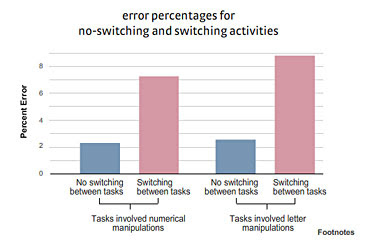 Source: Rogers RD & Monsell, S (1995) Depth of processing and the retention of words in episodic memory Journal of Experimental Psychology: General 124(2): 207 - 231 Table 2 of Experiment Cluster #1 (crosstalk conditions)
Notes: These trials involved uninterrupted (single-focus) tasks and interrupted (multiple-focus) tasks. Data are shown for experiments involving number-based manipulations and letter-based manipulations.
Some people, particularly younger people, are more adept at task-switching. If a person is familiar with the tasks, the completion time and errors are much less than if the tasks are unfamiliar. Still, taking your sequential brain into a multitasking environment can be like trying to put your right foot into your left shoe.
A good example is driving while talking on a cell phone. Until researchers started measuring the effects of cell-phone distractions under controlled conditions, nobody had any idea how profoundly they can impair a driver. It’s like driving drunk. Recall that large fractions of a second are consumed every time the brain switches tasks. Cell-phone talkers are a half-second slower to hit the brakes in emergencies, slower to return to normal speed after an emergency, and more wild in their “following distance” behind the vehicle in front of them. In a half-second, a driver going 70 mph travels 51 feet. Given that 80 percent of crashes happen within three seconds of some kind of driver distraction, increasing your amount of task-switching increases your risk of an accident. More than 50 percent of the visual cues spotted by attentive drivers are missed by cell-phone talkers. Not surprisingly, they get in more wrecks than anyone except very drunk drivers.
Watch the video below from the Brain Rules DVD.
It isn’t just talking on a cell phone. It’s putting on makeup, eating, rubber-necking at an accident. One study showed that simply reaching for an object while driving a car multiplies the risk of a crash or near-crash by nine times. Given what we know about the attention capacity of the human brain, these data are not surprising.
Do one thing at a time
The brain is a sequential processor, unable to pay attention to two things at the same time. Businesses and schools praise multitasking, but research clearly shows that it reduces productivity and increases mistakes. Try creating an interruption-free zone during the day—turn off your e-mail, phone, IM program, or BlackBerry—and see whether you get more done."


 Posts

